François Bernier quotes
Bernier says that the Rajput "Rajas never mount (guard) within a (Mughal) fortress, but invariably without the walls, under their own tents... and always refusing to enter any fortress unless well attended, and by men determined to sacrifice their lives for their leaders. This self devotion has been sufficiently proved when attempts have been made to deal treacherously with a Raja.”.

François Bernier
[In these circumstances the peasant had little interest in cultivating the land. Bernier observes that] "as the ground is seldom tilled otherwise than by compulsion... the whole country is badly cultivated, and a great part rendered unproductive... The peasant cannot avoid asking himself this question: Why should I toil for a tyrant who may come tomorrow and lay his rapacious hands upon all I possess and value... without leaving me the means (even) to drag my own miserable existence? - The Timariots (Timurids), Governors and Revenue contractors, on their part reason in this manner: Why should the neglected state of this land create uneasiness in our minds, and why should we expend our own money and time to render it fruitful? We may be deprived of it in a single moment... Let us draw from the soil all the money we can, though the peasant should starve or abscond...”.
François Bernier
[Francois Bernier, late in the seventeenth century, talks of originally "real Mongols”, "White men, foreigners”. He also says] "that children of the third and fourth generation, who have the brown complexion... are held in much less respect than new comers, and are seldom invested with official situations: they consider themselves happy, if permitted to serve as private soldiers in the infantry or cavalry.”.
François Bernier
The Omarahs mostly consist of adventurers from different nations who entice one another to the court; and are generally persons of low descent, some having been originally slaves, and the majority being destitute of education. The Mogol raises them to dignities, or degrades them to obscurity; according to his own pleasure and caprice.
François Bernier
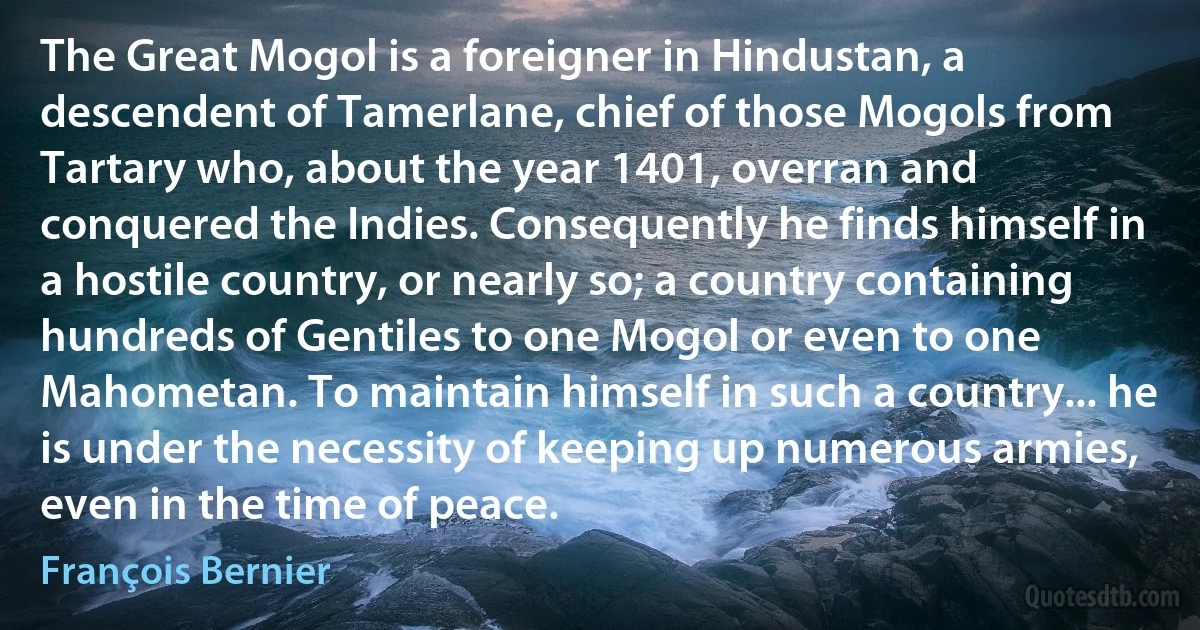
[According to Bernier, the Mughals maintained] "a large army for the purpose of keeping people in subjection... No adequate idea can be conveyed of the sufferings of the people. The cudgel and the whip compel them to incessant labour... their revolt or their flight is only prevented by the presence of a military force.”.
François Bernier
[Describing the bazar held in Delhi near the Red Fort, Francois Bernier (seventeenth century) says that] "Hither, likewise, the astrologers resort, both Mahometan and Gentile. These wise doctors remain seated in the sun, on a dusty piece of carpet, handling some old mathematical instruments, and having open before them a large book which represents the sign of the Zodiac. In this way they attract the attention of the passenger... by whom they are considered as so many infallible oracles. They tell a poor person his fortune for a payssa... Silly women, wrapping themselves in a white cloth from head to foot, flock to the astrologers, whisper to them all the transaction of their lives, and disclose every secret with no more reserve than is practised by a penitent in the presence of her confessor. The ignorant and infatuated people really believe that the stars have an influence (on their lives) which the astrologers can control.”.
François Bernier
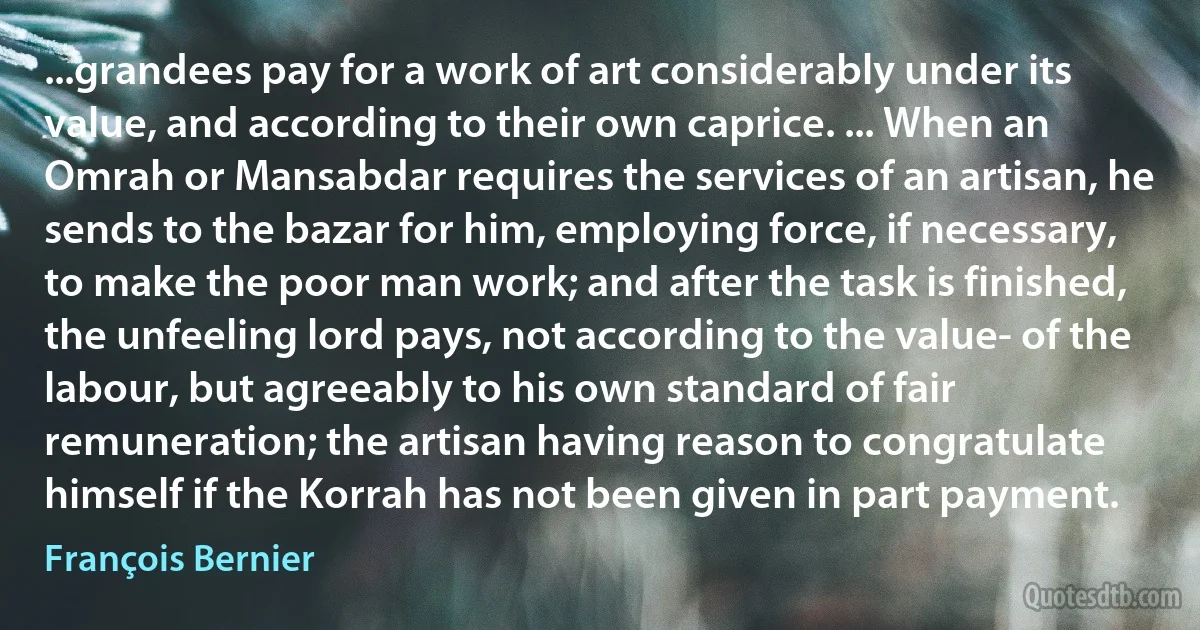
No artisan can be expected to give his mind to his calling in the midst of a people who are either wretchedly poor, or who, if rich, assume an appearance of poverty, and who regard not the beauty and excellence but the cheapness of an article; a people whose grandeess pay for a work of art considerably under its value and according to their own caprice... For it should not be inferred that the workman is held in esteem, or arrives at a stage of independence. Nothing but sheer necessity or blows from a cudgel keeps him employed; he never can become rich, and he feels it no trifling matter if he have the means of satisfying the cravings of hunger and of covering his body with the coarsest garment. If money be gained it does not in any measure go into his pocket, but only serves to increase the wealth of the merchant.
François Bernier