Maximus the Confessor quotes - page 2
When our intellect has shaken off its many opinions about created things, then the inner principle of truth appears clearly to it, providing it with a foundation of real knowledge and removing its former preconceptions as though removing scales from eyes, as happened in the case of St. Paul (cf. Acts 9:18). For an understanding of Scripture that does not go beyond the literal meaning, and a view of the sensible world that relies exclusively on sense perception, are indeed scales, blinding the soul's visionary faculty and preventing access to the pure Logos of truth.

Maximus the Confessor
For him who is perfect in love and has reached the summit of dispassion there is no difference between his own or another's, or between Christians and unbelievers, or between slave and free, or between male and female. But because he has risen above the tyranny of the passions and has fixed his attention on the single nature of man, he looks on all in the same way and shows the same disposition to all. For in him there is neither Greek nor Jew, male nor female, bond not free, but Christ who 'is all, and in all' (Col. 3:11; cf. Gal. 3:28).
Maximus the Confessor
The person who loves God cannot help loving every man as himself, even though he is grieved by the passions of those who are not yet purified. But when they amend their lives, his delight is indescribable and knows no bounds. A soul filled with thoughts of sensual desire and hatred is unpurified. If we detect any trace of hatred in our hearts against any man whatsoever for committing any fault, we are utterly estranged from love for God, since love for God absolutely precludes us from hating any man.
Maximus the Confessor
...one's movement towards the divine reaches its end only when one reaches God... 'The true Sabbaths are the rest laid up for the people of God' (Heb. 4:9). God can 'bear these sabbaths' (cf. Is. 1:13) because they are true. And the one 'in which the world is crucified' (Gal. 6:14) reaches these sabbaths of rest because he has clearly turned away from worldly things and returned to his own spiritual resting place. The one who arrives there will no longer be moved from his place, for there he finds quiet and tranquility.
Maximus the Confessor
A soul that is nurtured by hatred toward man can not be at peace with God, Who has said: If you forgive not men their sins, neither shall your Father forgive your sins (Matt. 6:15). If a man does not want to be reconciled, you must at least guard yourself from hating, praying with a pure heart for him, and speaking no evil of him.
Maximus the Confessor
If you expound the teaching of the Logos from the standpoint of the moral life, using materialistic words and examples which correspond to the capacity of your hearers, you make the Logos flesh. Conversely, if you elucidate mystical theology by means of the higher forms of contemplation you make the Logos spirit.
Maximus the Confessor
Those who seek the Lord should not look for Him outside themselves; on the contrary, they must seek Him within themselves through faith made manifest in action. For He is near you: 'The word is... in your mouth and in your heart, that is, the word of faith' (Rom. 10:8) - Christ being Himself the word that is sought.
Maximus the Confessor
The man who has struggled bravely with the passions of the body, has fought ably against unclean spirits, and has expelled from his soul the conceptual images they provoke, should pray for a pure heart to be given him and for a spirit of integrity to be renewed within him (cf. Ps. 51:10). In other words, he should pray that by grace he may be completely emptied of evil thoughts and filled with divine thoughts, so that he may become a spiritual world of God, splendid and vast, wrought from moral, natural and theological forms of contemplation.
Maximus the Confessor
When a man's intellect is constantly with God, his desire grows beyond all measure into an intense longing for God and his incensiveness is completely transformed into divine love. For by continual participation in the divine radiance his intellect becomes totally filled with light; and when it has reintegrated its passible aspect, it redirects this aspect towards God, filling it with an incomprehensible and intense longing for Him and with unceasing love, thus drawing it entirely away from worldly things to the divine.
Maximus the Confessor
'The long-suffering man abounds in understanding' (Prov. 14:29), because he endures everything to the end and, while awaiting that end, patiently bears his distress. The end, as St. Paul says, is everlasting life (cf. Rom. 6:22). 'And this is eternal life, that they might know You the only true God, and Jesus Christ whom You have sent' (Jn. 17:3).
Maximus the Confessor
A man of discernment, meditating on the healing Divine Providence, bears with thanksgiving the misfortunes that come to him. He sees their causes in his own sins, and not in anyone else. But a mindless man, when he sins and receives the punishment for it, considers the cause of his misfortune to be God, or people, not understanding God's care for him.
Maximus the Confessor
No benefit comes from a just man's prayer if he who asks for it finds more pleasure in sin than in virtue. For Samuel mourned over Saul when he sinned, but he was not able to obtain God's mercy, for his grief was not supported by the necessary change of life on the part of the sinner. Hence God put an end to the pointless grief of His servant, saying to him, 'How long will you mourn for Saul, seeing I have rejected him from reigning over Israel?' (I Sam. 16:1).
Maximus the Confessor
Before His visible advent in the flesh the Logos of God dwelt among the patriarchs and prophets in a spiritual manner, prefiguring the mysteries of His advent. After His incarnation He is present in a similar way not only to those who are still beginners, nourishing them spiritually and leading them toward the maturity of divine perfection, but also to the perfect, secretly pre-delineating in them the features of His future advent as if in an ikon.
Maximus the Confessor
Maximus the Confessor
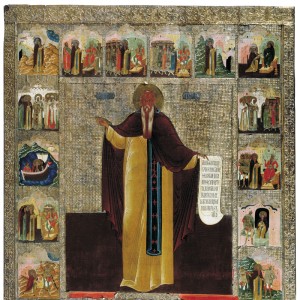 Born: 579
Died: August 13, 0662
Quotes count: 91
Related authors


