Plebeian Quotes

Truer notions of genetic physiology are given by the Hebrew expression "seed". If we speak of a man as "of the blood-royal" we think at once of plebeian dilution, and we wonder how much of the royal fluid is likely to be "in his veins"; but if we say he is "of the seed of Abraham" we feel something of the permanence and indestructibility of that germ which can be divided and scattered among all nations, but remains recognisable in type and characteristics after 4000 years.

William Bateson
I admire the proud and cold who go adventuring on the paths of great and demoniac beauty, and scorn "man" - but I do not envy them. For if anything is capable of making a poet out of a man of letters, it is this plebeian love of mine for the human, living, and commonplace. All warmth, all goodness, all humor is born of it, and it almost seems to me as if it were that love itself, of which it is written that a man might speak with the tongues of men and of angels, and yet without it be no more than sounding brass or a tinkling cymbal.
Thomas Mann
Since the beginning of our critical career, we have seen a vast deal of beautiful poetry pass into oblivion, in spite of our feeble efforts to recall or retain it in remembrance...The rich melodies of Keats and Shelley,-and the fantastical emphasis of Wordsworth,-and the plebeian pathos of Crabbe, are melting fast from the fields of our vision. The novels of Scott have put out his poetry. Even the splendid strains of Moore are fading into distance and dimness, except where they have been married to immortal music; and the blazing star of Byron himself is receding from its place of pride....The two who have the longest withstood this rapid withering of the laurel, and with the least marks of decay on their branches, are Rogers and Campbell.
Francis Jeffrey
The major difference between Astaire and Kelly is a difference, not of talent or technique, but of levels of sophistication. On the face of it, Kelly looks the more sophisticated. Where Kelly has ideas, Astaire has dance steps. Where Kelly has smartly tailored, dramatically apt Comden and Green scripts, Astaire in the Thirties made do with formulas derived from nineteenth-century French Farce. But the Kelly film is no longer a dance film. It's a story film with dances, as distinguished from a dance film with a story. When Fred and Ginger go into their dance, you see it as a distinct formal entity, even if it's been elaborately built up to in the script. In a Kelly film, the plot action and the musical set pieces preserve a smooth community of high spirits, so that the pressure in a dance number will often seem too low, the dance itself plebeian or folksy in order to "match up" with the rest of the picture.
Fred Astaire
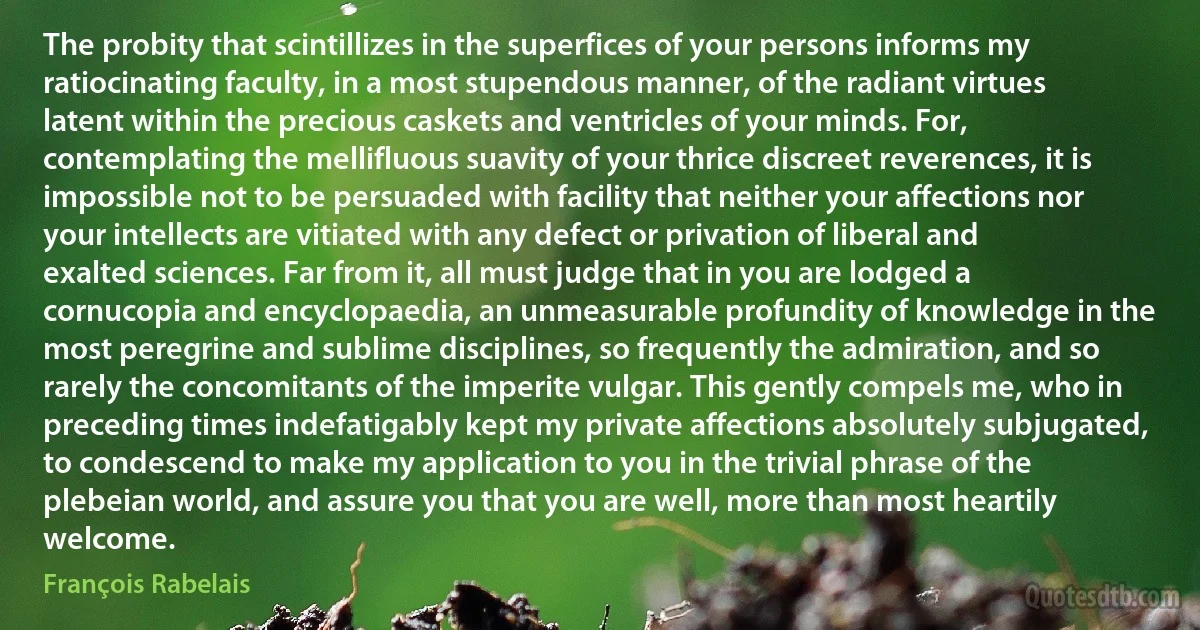
The sentiment that dominates all Rousseau's works is a certain plebeian anger that excites him against every kind of superiority. The energetic submission of the wise man bends nobly under the indispensable empire of social distinctions, and never does be appear greater than when he bows; but Rousseau has nothing at all of this loftiness. Weak and surly, he spent his life spouting insults to the great, as he would have offered the same to the people if he had been born a great lord.
Joseph de Maistre