Subtraction Quotes

I have throughout introduced the Integral Calculus in connexion with the Differential Calculus.... Is it always proper to learn every branch of a direct subject before anything connected with the inverse relation is considered? If so why are not multiplication and involution in arithmetic made to follow addition and precede subtraction? The portion of the Integral Calculus, which properly belongs to any given portion of the Differential Calculus increases its power a hundred-fold...

Augustus De Morgan
Experience has convinced me that the proper way of teaching is to bring together that which is simple from all quarters, and, if I may use such a phrase, to draw upon the surface of the subject a proper mean between the line of closest connexion and the line of easiest deduction. This was the method followed by Euclid, who, fortunately for us, never dreamed of a geometry of triangles, as distinguished from a geometry of circles, or a separate application of the arithmetics of addition and subtraction; but made one help out the other as he best could.
Augustus De Morgan
As for negative numbers... most mathematicians of the sixteenth and seventeenth centuries did not accept them... In the fifteenth century Nicolas Chuquet and, in the sixteenth, Stifel both spoke of negative numbers as absurd numbers. ...Descartes accepted them, in part. ...he had shown that, given an equation, one can obtain another whose roots are larger than the original one by any given quantity. Thus an equation with negative roots could be transformed into one with positive roots. Since we can turn false roots into real roots, Descartes was willing to accept negative numbers. Pascal regarded the subtraction of 4 from zero as utter nonsense.
Morris Kline
One of the first algebraists to accept negative numbers was... placed negative numbers on a par with positive numbers and gave both roots of a quadratic equation, even when both were negative. Both Girard and Harriot used the minus sign for the operation of subtraction and for negative numbers.
Morris Kline
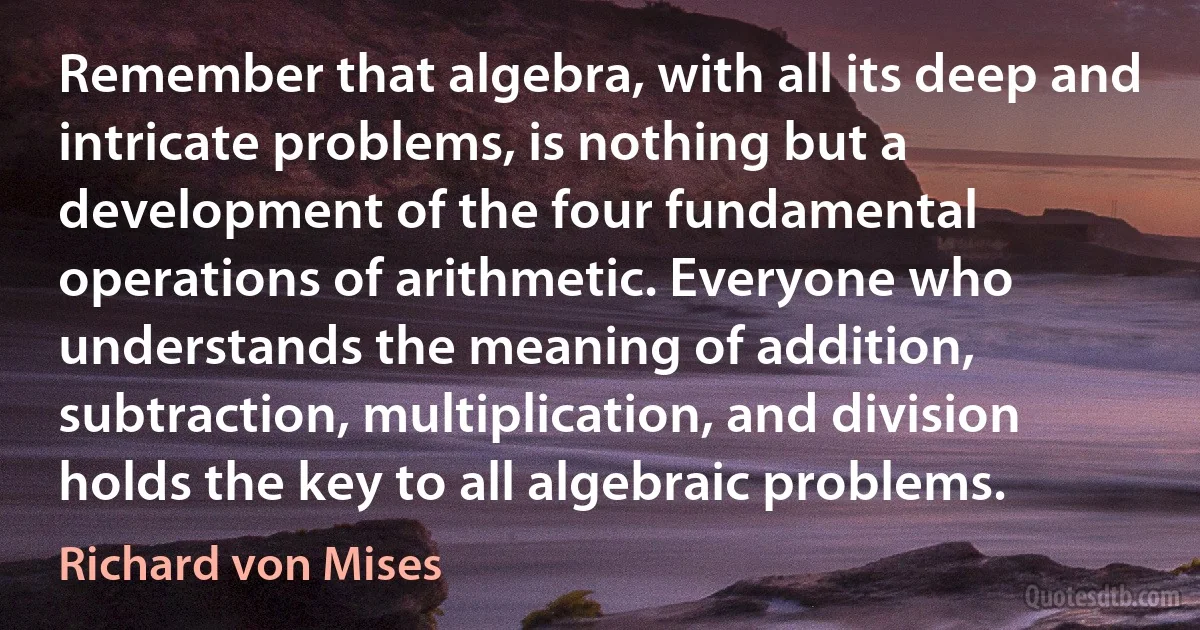
I have throughout introduced the Integral Calculus in connexion with the Differential Calculus. ...Is it always proper to learn every branch of a direct subject before anything connected with the inverse relation is considered? If so why are not multiplication and involution in arithmetic made to follow addition and precede subtraction?
Augustus De Morgan
Napier also invented a calculating device known as Napier's bones in 1617 and made common use of decimal multiplications and divisions. The device itself does not use logarithms, but rather is a convenient tool to reduce multiplication and division to a sequence of simple addition and subtraction operations. The method employed by Napier's bones was based on Arab mathematics and Fibonacci's Liber Abaci.
John Napier