Endeavouring Quotes - page 2
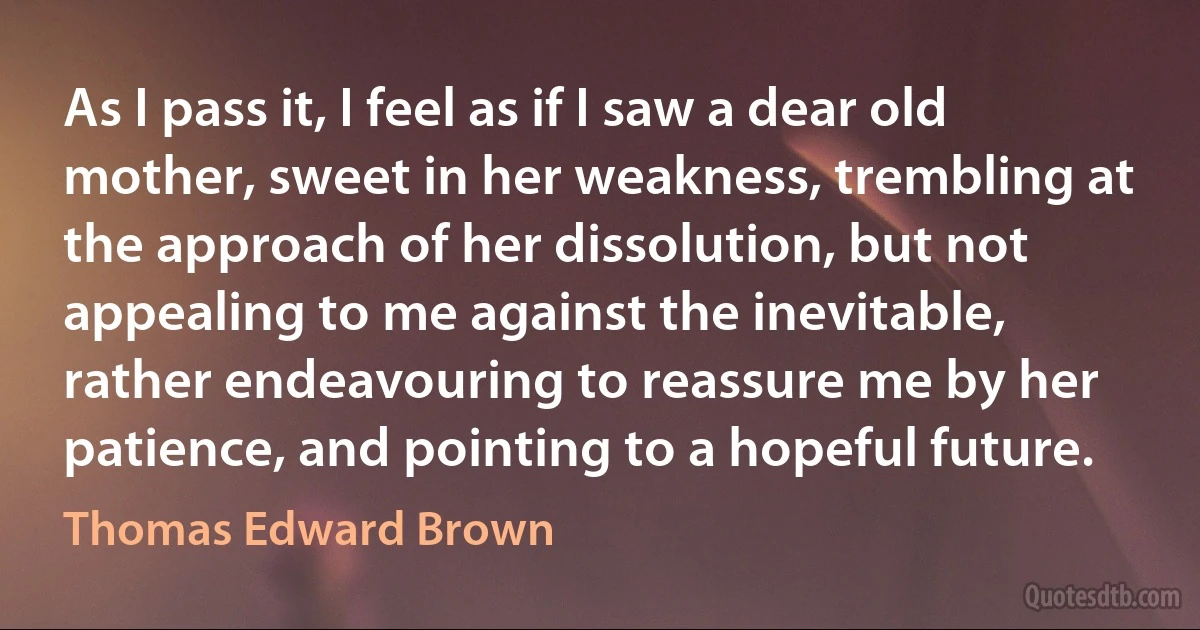
And so if any one would suppose that Æther (like our Air) may contain Particles which endeavour to recede from one another (for I do not know what this Æther is) and that its Particles are exceedingly smaller than those of Air, or even than those of Light: The exceeding smallness of its Particles may contribute to the greatness of the force by which those Particles may recede from one another, and thereby make that Medium exceedingly more rare and elastick than Air, and by consequence exceedingly less able to resist the motions of projectiles, and exceedingly more able to press upon gross Bodies, by endeavouring to expand it self.

Isaac Newton
Is not this Medium [æther] much rarer within the dense Bodies of the Sun, Stars, Planets, and Comets, than in the empty celestial Spaces between them? And in passing from them to great distances, doth it not grow denser and denser perpetually, and thereby cause the gravity of those great Bodies towards one another, and of their parts towards the Bodies; every Body endeavouring to go from the denser parts of the Medium towards the rarer? ...And though this Increase of density may at great distances be exceeding stow, yet if the elastick force of this Medium be exceeding great, it may suffice to impel Bodies from the denser parts of the Medium towards the rarer, with all that power which we call Gravity. And that the elastic force of this Medium is exceeding great, may be gather'd from the swiftness of its Vibrations.
Isaac Newton
The Sultan left Banarasi [Cuttack] with the intention of pursuing the Rai of Jajnagar, who had fled to an island in the river News was then brought that in the jangal were seven elephants, and one old she-elephant, which was very fierce. The Sultan resolved upon endeavouring to capture these elephants before continuing the pursuit of the Rai.... After the hunt was over, the Sultan directed his attention to the Rai of Jajnagar, and entering the palace where he dwelt he found many fine buildings. It is reported that inside the Rais fort, there was a stone idol which the infidels called Jagannath, and to which they paid their devotions. Sultan Firoz, in emulation of Mahmud Subuktigin, having rooted up the idol, carried it away to Delhi where he placed it in an ignominious position.
Firuz Shah Tughlaq
we should facilitate, instead of foolishly and vainly endeavouring to impede, the operations of nature in producing this mortality; and if we dread the too frequent visitation of the horrid form of famine, we should sedulously encourage the other forms of destruction, which we compel nature to use. Instead of recommending cleanliness to the poor, we should encourage contrary habits. In our towns we should make the streets narrower, crowd more people into the houses, and court the return of the plague. In the country, we should build our villages near stagnant pools, and particularly encourage settlements in all marshy and unwholesome situations.*12 But above all, we should reprobate specific remedies for ravaging diseases; and those benevolent, but much mistaken men, who have thought they were doing a service to mankind by projecting schemes for the total extirpation of particular disorders. http://www.econlib.org/library/Malthus/malPlong30.html#dd12 Book IV, Chapter V.
Thomas Malthus

After it hath been seen how the obstinate and the ignorant of evil disposition are accustomed to dispute, it will further be shewn how disputes are wont to conclude; although others are so wary that without losing their composure, but with a sneer, a smile, a certain discreet malice, that which they have not succeeded in proving by argument - nor indeed can it be understood by themselves - nevertheless by these tricks of courteous disdain they pretend to have proven, endeavouring not only to conceal their own patently obvious ignorance but to cast it on to the back of their adversary. For they dispute not in order to find or even to seek Truth, but for victory, and to appear the more learned and strenuous upholders of a contrary opinion. Such persons should be avoided by all who have not a good breastplate of patience.
Giordano Bruno
[Luigi Ferrarese] is an enlightened and philanthropic physician of Naples, who has for several years been zealously pursuing the study of Phrenology, and endeavouring to promote its application to those branches of science, morals and legislation, which he perceives it so well calculated to benefit. He has met with much persecution, but he has persevered, and it is with pleasure we perceive that there is one mind at least, in Naples, imbued with the importance of his views.
Luigi Ferrarese
Not that I at all disallow the use of reasoning upon experiments, or the endeavouring to discern as early as we can the confederations, and differences, and tendencies of things: for such an absolute suspension of the exercise of reasoning were exceeding troublesome, if not impossible. And, as in that rule of arithmetic, which is commonly called regula falsi by proceeding upon a conjecturally-supposed number, as if it were that, which we inquire after, we are wont to come to the knowledge of the true number sought for; so in physiology it is sometimes conducive to the discovery of truth, to permit the understanding to make an hypothesis, in order to the explication of this or that difficulty, that by examining how far the phænomena are, or are not, capable of being solved by that hypothesis, the understanding may, even by its own errors, be instructed.
Robert Boyle