Machiavelli Quotes - page 2
For a philosophy based on faith is no longer philosophy. Perhaps it was this unresolved conflict which has prevented Western thought from ever coming to rest. Perhaps it is this conflict which is at the bottom of a kind of thought which is philosophic indeed but no longer Greek: modern philosophy. It is in trying to understand modern philosophy that we come across Machiavelli. Machiavelli is the only political thinker whose name has come into common use for designating a kind of politics, which exists and will continue to exist independently of his influence, a politics guided exclusively by considerations of 'expediency, which uses all means, fair or foul, iron or poison, for achieving its ends-its end being the ag grandizement of one's country or fatherland-but also using the father land in the service of the self-aggrandizement of the politician or statesman or one's party.

Leo Strauss
Maurice Joly: In "Caesar” I bluntly accused our emperor of evil offenses...in ‘''this''' book I expose the nature of the man's mind, how he thinks, y'see!
Alphonse: But, Maurice, this Napoleon has seduced the public with social gifts...libraries and wars to give them national patriotic pride.
Maurice Joly: BAH! That is the kind of pallitative all dictators give their masses! But at what price? I ask you!
Alphonse: So...you show his plan by the dialogue of Machiavelli who is known as a cunning manipulator of political power, eh?
Maurice Joly: Yes, this is the clearest way to show the similarity of Napoleon's mind to Machiavelli's!
Alphonse: Hmmm! A clever device I must admit!
Will Eisner
Dialogue in Hell:
Twenty-First Dialogue
Machiavelli: I am afraid that you are somewhat prejudiced against loans;... modern economists today expressly recognize that, far from impoverishing the state, public debts enrich it. Will you allow me to explain how?
Montesquieu:.... I should first of all like to know from whom you will ask so much capital, and for what reason you will ask it.
Machiavelli: For that, foreign wars are a great help. In the great states, they permit the borrowing of five or six hundred millions; one manages so as to spend only half or two-thirds, and the rest finds its place in the treasury for domestic expenditures.
Will Eisner
Dialogue in Hell:
Thirteenth Dialogue
Machiavelli: This is because you do not understand, Montesquieu! How much impotence and even simplicity is found among the majority of men of European demagoguism. These tigers have souls of sheep, heads full of wind. Their dream is the absorption of the individual into a symbolic unity. They demand the complete realization of equality.
Will Eisner
Dialogue in Hell:
Seventeenth Dialogue
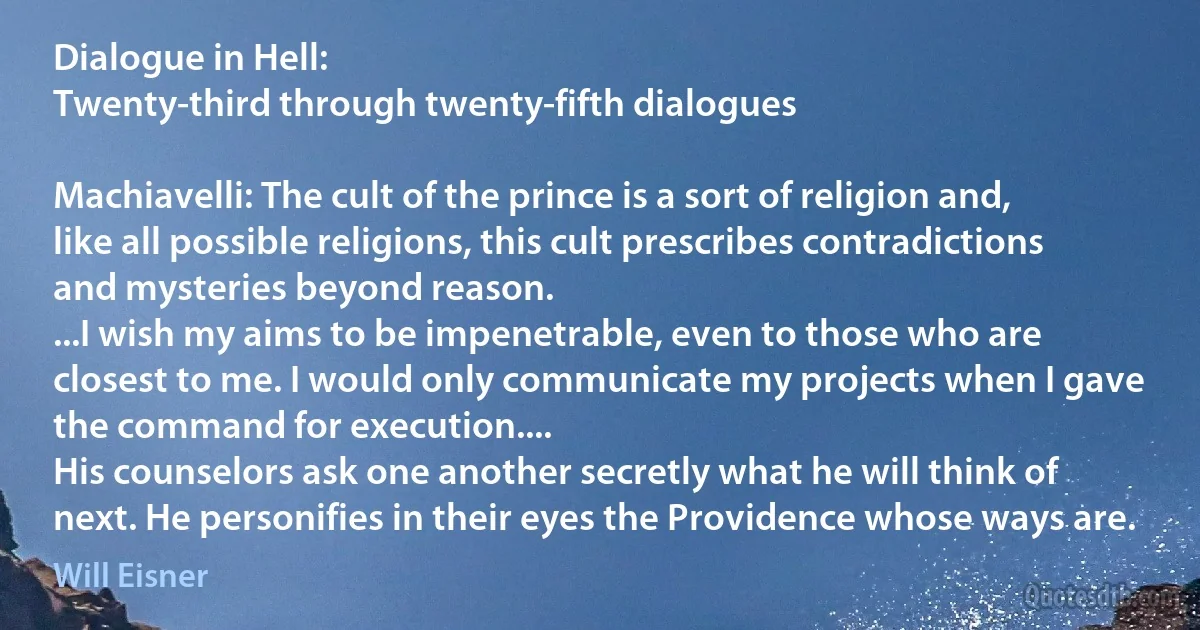
Montesquieu:... Now I understand the apologue the god Vishnu; you have a hundred arms like the Hindu idol and each one of your fingers touches a spring. In the same way that you touch everything, are you also able to see everything?
Machiavelli: Yes, for I shall make of the police an institution so vast that in the heart of my kingdom half of the people shall see the other half...
...If, as I scarcely doubt, I succeed in attaining this result, here are some of the forms by which my police would manifest themselves abroad: men of pleasure and good company in the foreign courts, to keep an eye on the intrigues of the princes and of the exiled pretenders...the establishment of political newspapers in the great capitals, printers and book stores places in the same conditions and secretly subsidized.
Will Eisner
Golovinski: Mr. Rachkovsky, a Zionist congress met last year. I can simply fabricate a manifesto!
Rachkovsky: Not good enough...and that will take too much time!
I have a solution!
Here is an old book by someone named Maurice Joly. It appeared here in France in 1864... and four years ago our journalist Decyon tried to use it to attack Russia's financial system.
Golovinski: The "Dialogue in hell between Machiavelli and Montesquie”!
Jolly's book attacks Napoleon III's government! It can be read as a plan for tyranny!
Rachkovsky: Exactly.
All you have to do is 'change this into a testament that emanates from the Jewish leaders...eh, Golovinski?
Golovinski: Ah, yes. A Jewish conspiracy! Yes, yes.
Will Eisner
Dialogue in Hell:
Ninth Dialogue
Machiavelli: And where have you ever seen that a constitution, really worthy of the name, really durable, has ever been the result of popular deliberation? A constitution must come forth fully armed from the head of one man alone, or it is nothing but a work condemned to oblivion. Without homogeneity, without linking of parties, without practical strength, it will necessarily bear the imprint of all the weaknesses of sight that have presided at its composition....
Montesquieu: ...One would say, to hear you, that you are going to draw a people out of chaos or out of the deep night of their first origins....
Machiavelli: I do not say no: therefore you will see that I need not destroy your institutions from top to bottom to arrive at my goal. It will suffice me to modify the arrangements and to change the methods.
Will Eisner
Dialogue in Hell:
First Dialogue
Machiavelli:...I am less preoccupied by what is good and moral than by what is useful and necessary.
...I will tell you that, as a witness in my homeland of the fickleness and the cowardice of the populace, of its innate taste for slavery, of its incapacity to conceive and to respect the conditions of free life; it is to my eyes a blind force which dissolves itself sooner or later, if it is not in the hands of a single man that it would never be able to administer, nor to judge, nor to make war....
Will Eisner
At this point, then, a junction is effected between the previously developed train of thought on countervailing passions and the doctrine of interest. Both doctrines originated in Machiavelli; yet the final outcome-the promotion of avarice to the position of the privileged passion given the job of taming the wild ones and of making in this fashion a crucial contribution to statecraft-would have greatly surprised and outraged him.
Albert O. Hirschman
When Machiavelli came to the end of his life, he had a vision shortly before giving up the ghost. He saw a small company of poor scoundrels, all in rags, ill-favoured, famished, and, in short, in as bad plight as possible. He was told that these were the inhabitants of paradise, of whom it is written, Beati pauperes, quoniam ipsorum est regnum caelorum.. After this, he was asked to which of the groups he would choose to belong; he answered that he would much rather be in Hell with those great geniuses, to converse with them about affairs of state, than be condemned to the company of the verminous scoundrels that he had first been shown.
Niccolò Machiavelli
When Machiavelli came to the end of his life, he had a vision shortly before giving up the ghost. He saw a small company of poor scoundrels, all in rags, ill-favoured, famished, and, in short, in as bad plight as possible. He was told that these were the inhabitants of paradise, of whom it is written, Beati pauperes, quoniam ipsorum est regnum caelorum.
Niccolò Machiavelli
When Machiavelli advises the Prince to carry out the Machiavellian scheme of action, he invests those actions with no sort of morality or beauty. For him morality remains what it is for everyone else, and does not cease to remain so because he observes (not without melancholy) that it is incompatible with politics. ... For him evil, even if it aids politics, still remains evil. The modern realists are the moralists of realism. For them, the act which makes the State strong is invested with a moral character by the fact that it does so, and this whatever the act may be. The evil which serves politics ceases to be evil and becomes good.
Julien Benda
The price man has to pay for the good things he enjoys is constant watchfulness lest they be employed for evil. Has not this been the case from the dawn of history with drink, language, and liberty? ...Let us take our stand on public right and a law of nations with Grotius rather than with Machiavelli; let us seek to moralise our public intercourse and reduce the area of casuistry and duplicity. That is not only the accepted principle of the best amongst us, but it is, I am sure, in harmony with a widespread instinct in the British people. It asserted itself in August 1914 when it was made plain that ethics was not a branch of politics, but the reverse.
Stanley Baldwin
I have shown you how Machiavelli supplied the immoral theory needful for the consummation of royal absolutism; the absolute oligarchy of Venice required the same assurance against the revolt of conscience. It was provided by a writer as able as Machiavelli, who analyzed the wants and resources of aristocracy, and made known that its best security is poison.
John W. Campbell