Quotesdtb.com
Popular Searches
Mark Twain
Marcus Aurelius
Albert Einstein
Oscar Wilde
Aristotle
Charlie Chaplin
Authors
Topics
Quotes
Home
Authors
Quotes of the day
Top quotes
Topics
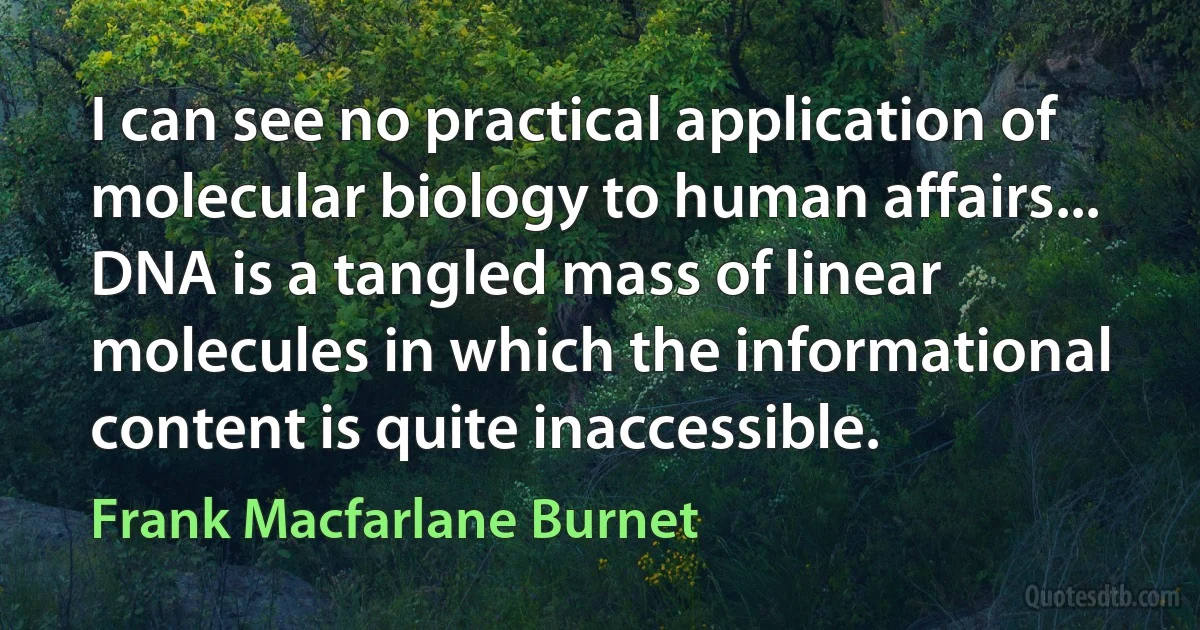
I can see no practical application of molecular biology to human affairs... DNA is a tangled mass of linear molecules in which the informational content is quite inaccessible.
Frank Macfarlane Burnet
Embed this Quote Image
×
Copy the code below to show this image on your website:
Embed code
<a href="https://www.quotesdtb.com/quote/11869466/frank-macfarlane-burnet-application" target="_blank" rel="noopener noreferrer"><img loading="lazy" src="https://cdn.quotesdtb.com/img/quotes_images_webp/17/frank-macfarlane-burnet-application-138717.webp" alt="I can see no practical application of molecular biology to human affairs... DNA is a tangled mass of linear molecules in which the informational content is quite inaccessible. (Frank Macfarlane Burnet)" style="max-width:1200px;width:100%;height:auto;border:0;display:block;" width="1200" height="630"></a>
Copy code
Code copied!
Add to your website
Related topics
biology
content
human
inaccessible
linear
mass
molecular
quite
see
affairs
Related quotes
The moment a little boy is concerned with which is a jay and which is a sparrow, he can no longer see the birds or hear them sing.
Eric Berne
I have yet to see any problem, however complicated, which, when you looked at it in the right way, did not become still more complicated.
Poul Anderson
Doctors prescribe medicine of which they know little to cure diseases of which they know lessen human beings of which they know nothing.
Voltaire
Mistakes are a part of being human. Appreciate your mistakes for what they are: precious life lessons that can only be learned the hard way. Unless it's a fatal mistake, which, at least, others can learn from.
Al Franken
Mathematicians have tried in vain to this day to discover some order in the sequence of prime numbers, and we have reason to believe that it is a mystery into which the human mind will never penetrate.
Leonhard Euler