Immanuel Kant quotes - page 10
The history of the human race, viewed as a whole, may be regarded as the realization of a hidden plan of nature to bring about a political constitution, internally, and for this purpose, also externally perfect, as the only state in which all the capacities implanted by her in mankind can be fully developed.

Immanuel Kant
Ours is an age of criticism, to which everything must be subjected. The sacredness of religion, and the authority of legislation, are by many regarded as grounds for exemption from the examination by this tribunal, But, if they are exempted, and cannot lay claim to sincere respect, which reason accords only to that which has stood the test of a free and public examination.
Immanuel Kant
But where only a free play of our presentational powers is to be sustained as in the case of pleasure gardens, room decoration, all sorts of useful utensils, and so on, any regularity that has an air of constraint is to be avoided as much as possible. That is why the English taste in gardens, or the baroque taste in furniture, carries the imagination's freedom very far, even to the verge of the grotesque, because it is precisely this divorce from any constraint of a rule that the case is posited where taste can show its greatest perfection in designs made by the imagination.
Immanuel Kant
To be beneficent when we can is a duty and besides this, there are many minds so sympathetically constituted that, without any other motive of vanity or self-interest, they find a pleasure in spreading joy around them, and can take delight in the satisfaction of others so far as it is their own work. But I maintain that in such a case an action of this kind, however proper, however amiable it may be, has nevertheless no true moral worth, but is on a level with other inclinations.... For the maxim lacks the moral import, namely, that such actions be done from duty, not from inclination.
Immanuel Kant
... as to moral feeling, this supposed special sense, the appeal to it is indeed superficial when those who cannot think believe that feeling will help them out, even in what concerns general laws and besides, feelings which naturally differ infinitely in degree cannot furnish a uniform standard of good and evil, nor has any one a right to form judgments for others by his own feelings....
Immanuel Kant
A public can only arrive at enlightenment slowly. Through revolution, the abandonment of personal despotism may be engendered and the end of profit-seeking and domineering oppression may occur, but never a true reform of the state of mind. Instead, new prejudices, just like the old ones, will serve as the guiding reins of the great, unthinking mass.
All that is required for this enlightenment is freedom; and particularly the least harmful of all that may be called freedom, namely, the freedom for man to make public use of his reason in all matters. But I hear people clamor on all sides: Don't argue! The officer says: Don't argue, drill! The tax collector: Don't argue, pay! The pastor: Don't argue, believe!
Immanuel Kant
Since men in their endeavors behave, on the whole, not just instinctively, like the brutes, nor yet like rational citizens of the world according to some agreed-on plan, no history of man conceived according to a plan seems to be possible, as it might be possible to have such a history of bees or beavers. One cannot suppress a certain indignation when one sees men's actions on the great world-stage and finds, beside the wisdom that appears here and there among individuals, everything in the large woven together from folly, childish vanity, even from childish malice and destructiveness. In the end, one does not know what to think of the human race, so conceited in its gifts.
Immanuel Kant
I do not, therefore, need any penetrating acuteness to see what I have to do in order that my volition be morally good. Inexperienced in the course of the world, incapable of being prepared for whatever might come to pass in it, I ask myself only: can you also will that your maxim become a universal law?
Immanuel Kant
A plant, an animal, the regular order of nature - probably also the disposition of the whole universe - give manifest evidence that they are possible only by means of and according to ideas; that, indeed, no one creature, under the individual conditions of its existence, perfectly harmonizes with the idea of the most perfect of its kind - just as little as man with the idea of humanity, which nevertheless he bears in his soul as the archetypal standard of his actions; that, notwithstanding, these ideas are in the highest sense individually, unchangeably, and completely determined, and are the original causes of things; and that the totality of connected objects in the universe is alone fully adequate to that idea.
Immanuel Kant
![[T]he first characteristic of the human species is man's ability, as a rational being, to establish character for himself, as well as for the society into which nature has placed him. This ability, however, presupposes an already favorable natural predisposition and an inclination to the good in man, because the evil is really without character (since it is at odds with itself, and since it does not tolerate any lasting principle within itself) (Immanuel Kant)](https://cdn.quotesdtb.com/img/quotes_images_webp/62/immanuel-kant-ability-character-1008962.webp)
The more one presupposes that his own power will suffice him to realize what he desires the more practical is that desire. When I treat a man contemptuously, I can inspire him with no practical desire to appreciate my grounds of truth. When I treat any one as worthless, I can inspire him with no desire to do right.
Immanuel Kant
Man has his own inclinations and a natural will which, in his actions, by means of his free choice, he follows and directs. There can be nothing more dreadful than that the actions of one man should be subject to the will of another; hence no abhorrence can be more natural than that which a man has for slavery. And it is for this reason that a child cries and becomes embittered when he must do what others wish, when no one has taken the trouble to make it agreeable to him. He wants to be a man soon, so that he can do as he himself likes.
Immanuel Kant
Immanuel Kant
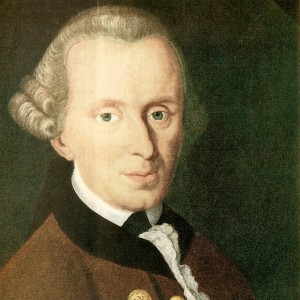 Occupation: German Philosopher
Born: April 22, 1724
Died: February 12, 1804
Quotes count: 249
Wikipedia: Immanuel Kant

Related authors


