George Eliot quotes - page 12
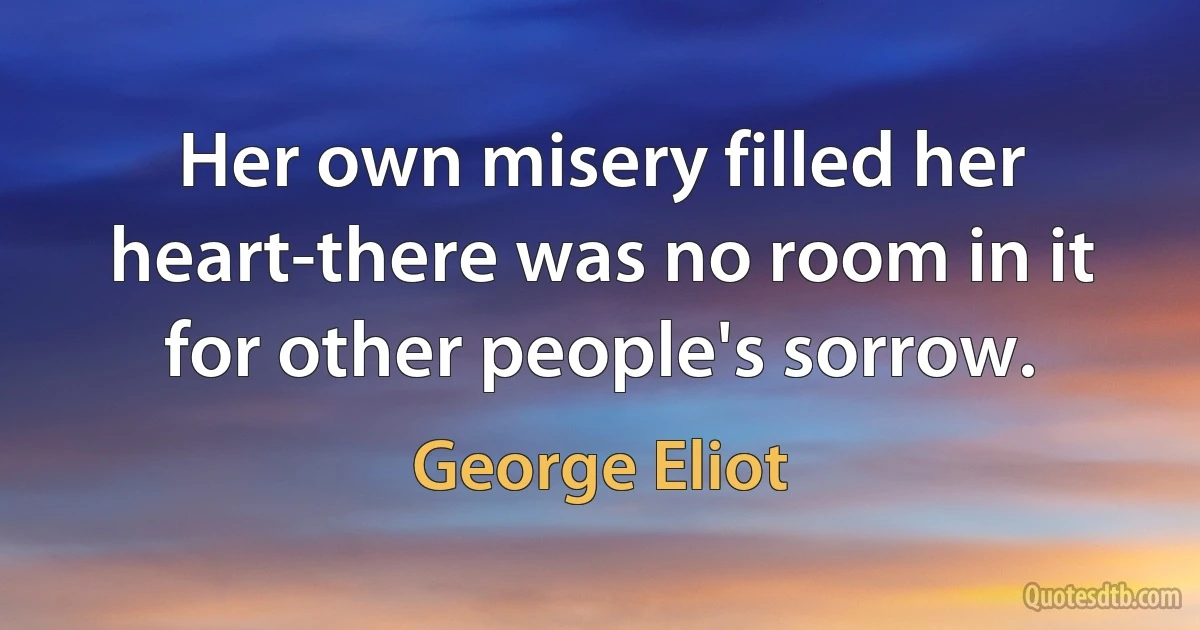
Truth is the precious harvest of the earth.
But once, when harvest waved upon a land,
The noisome cankerworm and caterpillar,
Locusts, and all the swarming foul-born broods,
Fastened upon it with swift, greedy jaws,
And turned the harvest into pestilence,
Until men said, What profits it to sow?

George Eliot
They kissed each other with a deep joy.
What greater thing is there for two human souls, than to feel that they are joined for life - to strengthen each other in all labour, to rest on each other in all sorrow, to minister to each other in all pain, to be one with each other in silent unspeakable memories at the moment of the last parting?
George Eliot
But a morbid consciousness that others did not give him the place which he had not demonstrably merited-a perpetual suspicious conjecture that the views entertained of him were not to his advantage- a melancholy absence of passion in his efforts at achievement, and a passionate resistance to the confession that he had achieved nothing.
George Eliot
I suppose one reason why we are seldom able to comfort our neighbours with our words is that our goodwill gets adulterated, in spite of ourselves, before it can pass our lips. We can send black puddings and petticoes without giving them a flavour of our own egoism; but language is a stream that is almost sure to smack of a mingled soil. There was a fair proportion of kindness in Raveloe; but it was often of a beery and bungling sort, and took the shape least allied to the complimentary and hypocritical.
George Eliot
Already handbills were in circulation; some presenting, in large print, the alternative of justice on the conspirators or ruin to the Republic; others in equally large print urging the observance of the law and the granting of the Appeal. Round these jutting islets of black capitals there were lakes of smaller characters setting forth arguments less necessary to be read: for it was an opinion entertained at that time (in the first flush of triumph at the discovery of printing), that there was no argument more widely convincing than question-begging phrases in large type.
George Eliot
Rosamond felt herself beginning to know a great deal of the world, especially in discovering what when she was in her unmarried girlhood had been inconceivable to her except as a dim tragedy in by-gone costumes- that women, even after marriage, might make conquests and enslave men. Still, vanity, with a woman's whole mind and day to work in, can construct abundantly on slight hints, especially on such a hint as the possibility of indefinite conquests. How delightful to make captives from the throne of marriage with a husband as crown-prince by your side-himself in fact a subject- while the captives look up forever hopeless, losing their rest probably, and if their appetite too, so much the better!
George Eliot

This was not the first time that Mr. Bulstrode had begun by admonishing Mr. Vincy, and had ended by seeing a very unsatisfactory reflection of himself in the coarse unflattering mirror which that manufacturer's mind presented to the subtler lights and shadows of his fellowmen; and perhaps his experience ought to have warned him how the scene would end. But a full-fed fountain will be generous with its waters even in the rain, when they are worse than useless; and a fine fount of admonition is apt to be equally irrepressible.
George Eliot
His mind was destitute of that dread which has been erroneously decried as if it were nothing higher than a man's animal care for his own skin: that awe of the Divine Nemesis which was felt by religious pagans, and, though it took a more positive form under Christianity, is still felt by the mass of mankind simply as a vague fear at anything which is called wrong-doing. Such terror of the unseen is so far above mere sensual cowardice that it will annihilate that cowardice: it is the initial recognition of a moral law restraining desire, and checks the hard bold scrutiny of imperfect thought into obligations which can never be proved to have any sanctity in the absence of feeling.
George Eliot
That Spanish woman who lived three hundred years ago, was certainly not the last of her kind. Many Theresas have been born who found for themselves no epic life wherein there was a constant unfolding of far-resonant action; perhaps only a life of mistakes, the offspring of a certain spiritual grandeur ill-matched with the meanness of opportunity; perhaps a tragic failure which found no sacred poet and sank unwept into oblivion.
George Eliot
She could not reconcile the anxieties of a spiritual life involving eternal consequences, with a keen interest in gimp and artificial protrusions of drapery. Her mind was theoretic, and yearned by its nature after some lofty conception of the world which might frankly include the parish of Tipton and her own rule of conduct there; she was enamoured of intensity and greatness, and rash in embracing whatever seemed to her to have those aspects; likely to seek martyrdom, to make retractations, and then to incur martyrdom after all in a quarter where she had not sought it. Certainly such elements in the character of a marriageable girl tended to interfere with her lot, and hinder it from being decided according to custom, by good looks, vanity, and merely canine affection.
George Eliot