Robert Graves quotes - page 6
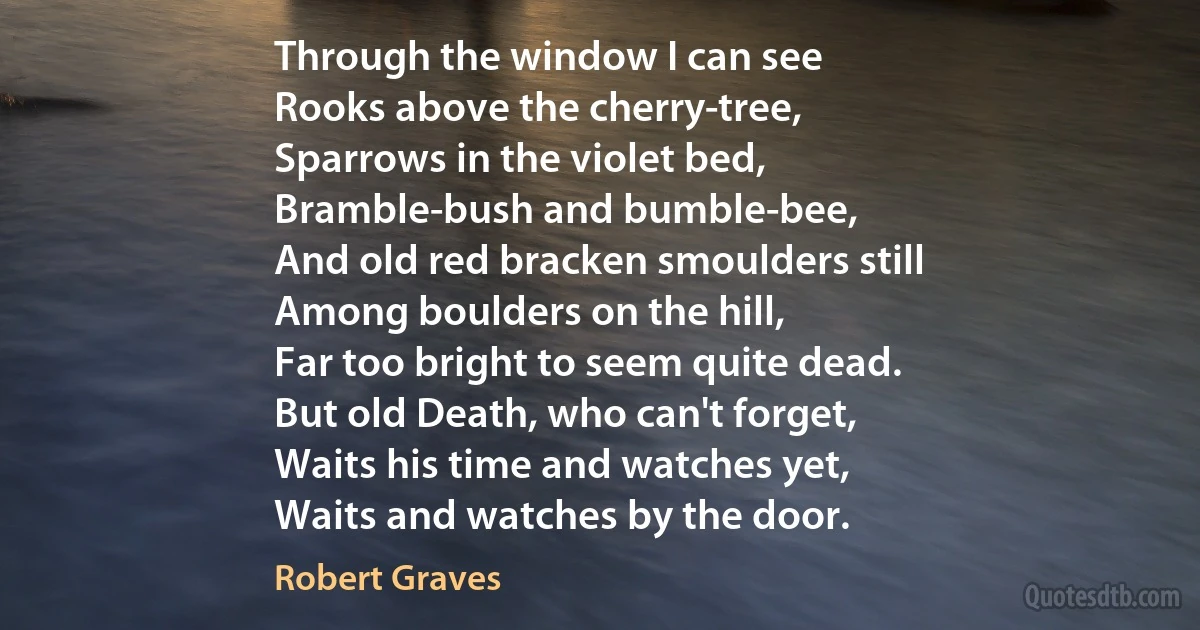
Where nature with accustomed round
Sweeps and garnishes the ground
With kindly beauty, warm or cold -
Alternate seasons never old:
Heathen, how furiously you rage,
Cursing this blood and brimstone age,
How furiously against your will
You kill and kill again, and kill:
All thought of peace behind you cast,
Till like small boys with fear aghast,
Each cries for God to understand,
'I could not help it, it was my hand.'"

Robert Graves
I do not love the Sabbath, The soapsuds and the starch, The troops of solemn people Who to Salvation march. I take my book, I take my stick On the Sabbath day, In woody nooks and valleys I hide myself away. To ponder there in quiet God's Universal Plan, Resolved that church and Sabbath Were never made for man.
Robert Graves
Children, if you dare to think
Of the greatness, rareness, muchness,
Fewness of this precious only
Endless world in which you say
You live, you think of things like this:
Blocks of slate enclosing dappled
Red and green, enclosing tawny
Yellow nets, enclosing white
And black acres of dominoes,
Where a neat brown paper parcel
Tempts you to untie the string.
Robert Graves
Another War soon gets begun,
A dirtier, a more glorious one;
Then, boys, you'll have to play, all in;
It's the cruellest team will win.
So hold your nose against the stink
And never stop too long to think.
Wars don't change except in name;
The next one must go just the same,
And new foul tricks unguessed before
Will win and justify this War.
Robert Graves
Opposite our trenches a German salient protruded, and the brigadier wanted to "bite it off" in proof of the division's offensive spirit. Trench soldiers could never understand the Staff's desire to bite off an enemy salient. It was hardly desirable to be fired at from both flanks; if the Germans had got caught in a salient, our obvious duty was to keep them there as long as they could be persuaded to stay. We concluded that a passion for straight lines, for which headquarters were well known, had dictated this plan, which had no strategic or tactical excuse.
Robert Graves
In the middle of a lecture I would have a sudden very clear experience of men on the march up the Béthune–La Bassée road; the men would be singing... These daydreams persisted like an alternate life and did not leave me until well in 1928. The scenes were nearly always recollections of my first four months in France; the emotion-recording apparatus seems to have failed after Loos.
Robert Graves
I, Tiberius Claudius Drusus Nero Germanicus ... this, that and the other (for I shall not trouble you yet with all my titles), who was once, and not so long ago either, known to my friends and relatives and associates as ‘Claudius the [[Idiot]', or ‘That Claudius', or ‘Claudius the Stammerer', or ‘Clau-Clau-Claudius', or at best as ‘Poor Uncle Claudius', am now about to write this strange history of my life; starting from my earliest childhood and continuing year by year until I reach the fateful point of change where, some eight years ago, at the age of fifty-one, I suddenly found myself caught in what I may call the ‘golden predicament' from which I have never since become disentangled.
Robert Graves
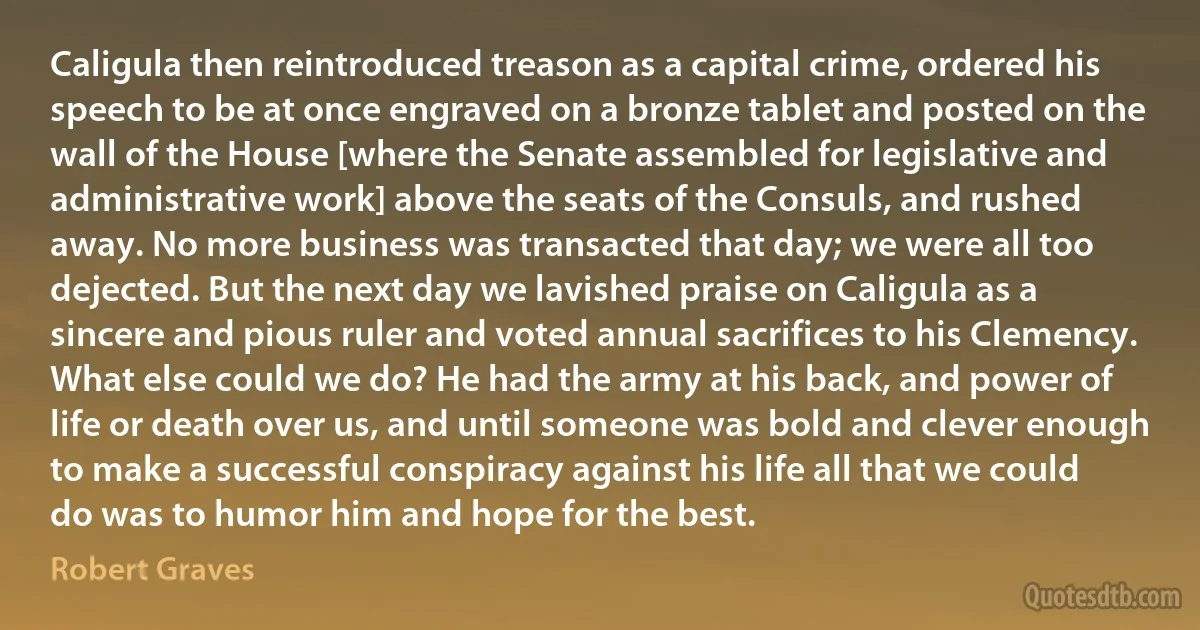
Where is good English to be found? Not among those who might be expected to write well professionally. Schoolmasters seldom write well: it is difficult for any teacher to avoid either pomposity or, in the effort not to be pompous, a jocular conversational looseness. The clergy suffer from much the same occupational disability: they can seldom decide whether to use "the language of the market-place" or Biblical rhetoric. Men of letters usually feel impelled to cultivate an individual style - less because they feel sure of themselves as individuals than because they wish to carve a niche for themselves in literature; and nowadays an individual style usually means merely a peculiar range of inaccuracies, ambiguities, logical weaknesses and stylistic extravagancies. Trained journalists use a flat, over-simplified style, based on a study of what sells a paper and what does not, which is inadequate for most literary purposes.
Robert Graves