G. K. Chesterton quotes - page 18
The truth is that it is our attitude towards children that is right, and our attitude towards grown-up people that is wrong. Our attitude towards our equals in age consists in a servile solemnity, overlying a considerable degree of indifference or disdain. Our attitude towards children consists in a condescending indulgence, overlying an unfathomable respect.

G. K. Chesterton
When we reverence anything in the mature, it is their virtues or their wisdom, and this is an easy matter. But we reverence the faults and follies of children.
We should probably come considerably nearer to the true conception of things if we treated all grown-up persons, of all titles and types, with precisely that dark affection and dazed respect with which we treat the infantile limitations.
G. K. Chesterton
The humorous look of children is perhaps the most endearing of all the bonds that hold the Cosmos together. Their top-heavy dignity is more touching than any humility; their solemnity gives us more hope for all things than a thousand carnivals of optimism; their large and lustrous eyes seem to hold all the stars in their astonishment; their fascinating absence of nose seems to give to us the most perfect hint of the humour that awaits us in the kingdom of heaven.
G. K. Chesterton
The whole modern world has divided itself into Conservatives and Progressives. The business of Progressives is to go on making mistakes. The business of Conservatives is to prevent mistakes from being corrected. Even when the revolutionist might himself repent of his revolution, the traditionalist is already defending it as part of his tradition. Thus we have two great types - the advanced person who rushes us into ruin, and the retrospective person who admires the ruins. He admires them especially by moonlight, not to say moonshine. Each new blunder of the progressive or prig becomes instantly a legend of immemorial antiquity for the snob. This is called the balance, or mutual check, in our Constitution.
G. K. Chesterton
Humility is the luxurious art of reducing ourselves to a point, not to a small thing or a large one, but to a thing with no size at all, so that to it all the cosmic things are what they really are - of immeasurable stature. That the trees are high and the grasses short is a mere accident of our own foot-rules and our own stature. But to the spirit which has stripped off for a moment its own idle temporal standards the grass is an everlasting forest, with dragons for denizens; the stones of the road are as incredible mountains piled one upon the other; the dandelions are like gigantic bonfires illuminating the lands around; and the heath-bells on their stalks are like planets hung in heaven each higher than the other.
G. K. Chesterton
The essential rectitude of our view of children lies in the fact that we feel them and their ways to be supernatural while, for some mysterious reason, we do not feel ourselves or our own ways to be supernatural. The very smallness of children makes it possible to regard them as marvels; we seem to be dealing with a new race, only to be seen through a microscope. I doubt if anyone of any tenderness or imagination can see the hand of a child and not be a little frightened of it. It is awful to think of the essential human energy moving so tiny a thing; it is like imagining that human nature could live in the wing of a butterfly or the leaf of a tree. When we look upon lives so human and yet so small, we feel as if we ourselves were enlarged to an embarrassing bigness of stature. We feel the same kind of obligation to these creatures that a deity might feel if he had created something that he could not understand.
G. K. Chesterton
The pessimists are aristocrats like Byron; the men who curse God are aristocrats like Swinburne. But when those who starve and suffer speak for a moment, they do not profess merely an optimism, they profess a cheap optimism; they are too poor to afford a dear one. They cannot indulge in any detailed or merely logical defence of life; that would be to delay the enjoyment of it. These higher optimists, of whom Dickens was one, do not approve of the universe; they do not even admire the universe; they fall in love with it. They embrace life too close to criticize or even to see it. Existence to such men has the wild beauty of a woman, and those love her with most intensity who love her with least cause.
G. K. Chesterton
For fear of the newspapers politicians are dull, and at last they are too dull even for the newspapers. The speeches in our time are more careful and elaborate, because they are meant to be read, and not to be heard. And exactly because they are more careful and elaborate, they are not so likely to be worthy of a careful and elaborate report. They are not interesting enough. So the moral cowardice of modern politicians has, after all, some punishment attached to it by the silent anger of heaven. Precisely because our political speeches are meant to be reported, they are not worth reporting. Precisely because they are carefully designed to be read, nobody reads them.
G. K. Chesterton
It is incomprehensible to me that any thinker can calmly call himself a modernist; he might as well call himself a Thursdayite. ... The real objection to modernism is simply that it is a form of snobbishness. It is an attempt to crush a rational opponent not by reason, but by some mystery of superiority, by hinting that one is specially up to date or particularly "in the know." To flaunt the fact that we have had all the last books from Germany is simply vulgar; like flaunting the fact that we have had all the last bonnets from Paris. To introduce into philosophical discussions a sneer at a creed's antiquity is like introducing a sneer at a lady's age. It is caddish because it is irrelevant. The pure modernist is merely a snob; he cannot bear to be a month behind the fashion.
G. K. Chesterton
I swear to you, then," said MacIan, after a pause. "I swear to you that nothing shall come between us. I swear to you that nothing shall be in my heart or in my head till our swords clash together. I swear it by the God you have denied, by the Blessed Lady you have blasphemed; I swear it by the seven swords in her heart. I swear it by the Holy Island where my fathers are, by the honour of my mother, by the secret of my people, and by the chalice of the Blood of God."
The atheist drew up his head. "And I," he said, "give my word.
G. K. Chesterton
It is something to have wept as we have wept,
It is something to have done as we have done,
It is something to have watched when all men slept,
And seen the stars which never see the sun.
It is something to have smelt the mystic rose,
Although it break and leave the thorny rods,
It is something to have hungered once as those
Must hunger who have ate the bread of gods.
G. K. Chesterton
Those dry Deists and hard-headed Utilitarians who stalked the streets of Edinburgh and Glasgow in the eighteenth and early nineteenth centuries were very obviously the products of the national religious spirit. The Scottish atheists were unmistakable children of the Kirk. And though they often seemed absurdly detached and dehumanised, the world is now rather suffering for want of such dull lucidity.
G. K. Chesterton
[G]uesses about the fashions of the future are generally quite wide of the mark, because they are founded on a very obvious fallacy. They always imply that public taste will continue to progress in its present direction; which is, in truth, the only thing we know that it will not do. A thing that wanders away in great winding curves may end anywhere; but to turn each curve into a straight line striking out into the void will be wrong in any case.
G. K. Chesterton
G. K. Chesterton
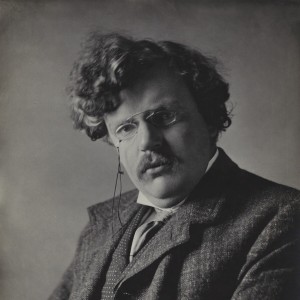 Occupation: English Author
Born: May 29, 1874
Died: June 14, 1936
Quotes count: 449
Wikipedia: G. K. Chesterton

Related authors


